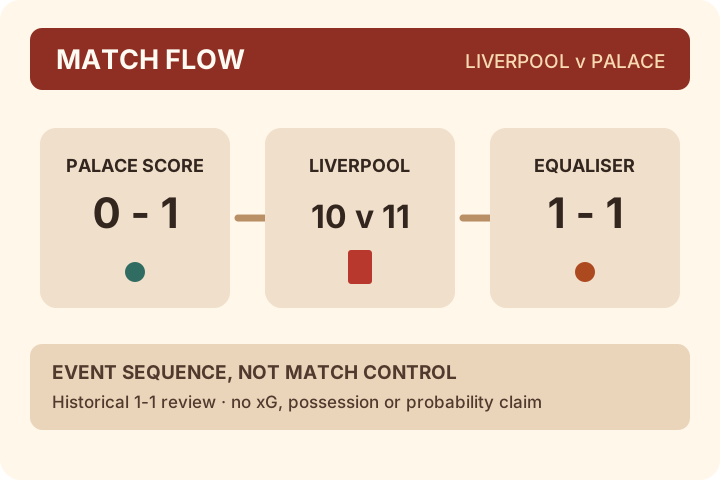
At Anfield on 15 August 2022, a 1-1 result can easily be reduced to “Liverpool equalised with 10 men”. A historical post-match analysis should first ask which events are confirmed by both clubs’ reports, and which are reasonable questions raised by those events. This article concerns that match only; it is not a current preview or betting recommendation.[1]
Confirmed event sequence
Liverpool and Crystal Palace both recorded the same essentials: Wilfried Zaha put Palace ahead in the 32nd minute; Darwin Nunez was sent off in the 56th; Luis Diaz levelled for Liverpool in the 61st. Palace still had a late Zaha effort hit the post, while Joachim Andersen also had a late attempt. Those events support the statement that both sides remained threatening after the equaliser. The score alone cannot show that the side drawing level had taken complete control.[1]

What Palace’s goal does, and does not, show
Liverpool’s report describes Eberechi Eze playing Zaha in behind after a Liverpool attack; Palace likewise records an Eze assist and a Zaha counterattack. That confirms usable space behind the defence in that phase. It does not establish that Liverpool left the same gap after every attack, and one counterattack cannot define an entire season’s defensive pattern.[1]
The reports also offer their own perspectives. Liverpool records several early chances and Nunez hitting the post before half-time; Palace stresses organisation without the ball and their counterattacking threat. Those accounts need not contradict each other, but both are club narratives, not neutral measures of possession, pressing or chance quality.
Read the red card and equaliser separately
Diaz’s individual equaliser after Nunez’s dismissal shows Liverpool could still score with 10 players. It is not evidence that the dismissal had no effect: player numbers, scoreline, substitutions and Palace’s response all changed together. Equally, Palace’s later effort against the post does not by itself prove they were certain to win. The two moments simply show that the equaliser was not the end of the match process.
Limits and competing readings
Looking only at the result, each side took a point. Focusing only on Diaz’s equaliser risks overlooking Palace’s threat while leading and late on; focusing only on Zaha’s counterattack overlooks Liverpool scoring despite the numerical disadvantage. There is no complete same-provider shot-by-shot, expected-goals, possession or full-match-video analysis in this evidence set. This article therefore does not convert club reports into rankings, win probabilities, handicap calls or totals calls.
Evidence-based conclusion
The most useful reading of this 1-1 is to keep “counterattacking opener, red card, 10-man equaliser and later chances” as separate facts. The evidence supports this conclusion: Liverpool’s equaliser did not erase Palace’s transition and late threat, while Palace’s counterattacking goal cannot summarise Liverpool’s whole display. A firmer judgement about control would require comparable chance data and complete footage, not a guarantee built from any one incident.
Sources and scope of review
The previously cited Liverpool FC match-report URL now returns 404, so the broken link has been removed; the Crystal Palace official report below remains accessible.
- Crystal Palace FC: Palace secure well-deserved point at Anfield
Published 15 August 2022; checked 17 October 2026 (Hong Kong). Used to cross-check the score, event minutes, counterattacking goal and late chances.
This is an original analysis organised from the public club reports. Neither report is a complete event dataset or a neutral technical study. No human editorial review, full-web duplication check or new comprehensive fact-check is claimed.