Arsenal had four wins and one defeat; Leeds United had two wins and three draws. Which start was more persuasive? Across the five available Premier League rounds, Arsenal turned more matches into wins, while Leeds conceded fewer goals and remained unbeaten. Both observations are true. This article gives weight to Arsenal’s points return, but Leeds’ defensive results are meaningful counter-evidence and do not support a one-sided forecast.[1]
This is an early 2026/27 Premier League analysis of Arsenal at home to Leeds, kicking off at 19:30 Hong Kong time on 10 October 2026. The time reflects the verified rescheduling. Confirmed line-ups, a complete current injury list and live data were not available. The original data cutoff and later editorial revision are recorded separately below.[2][3]
Five-match facts: wins and an unbeaten run measure different things
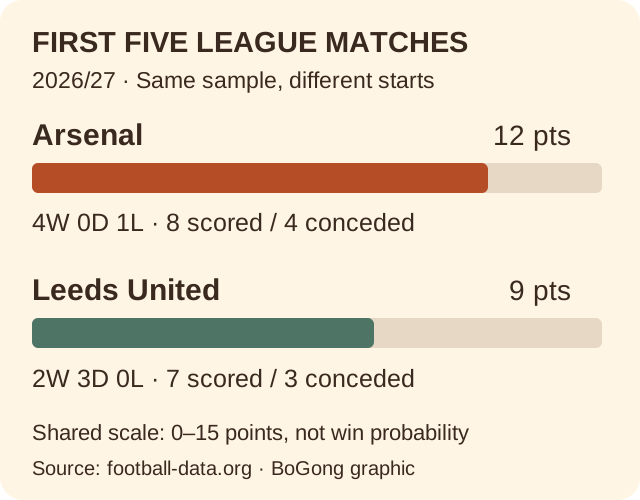
The sample uses one definition: completed regulation-time results from rounds one to five of the 2026/27 Premier League, with three points for a win and one for a draw. Cups, friendlies, extra time and shoot-outs are excluded. Arsenal collected 12 points and Leeds nine; Arsenal scored eight and conceded four, Leeds scored seven and conceded three. All ten results can be checked in the source section.[1]
Our reading: Leeds’ unbeaten label means they did not lose, but three draws produced only three points. Arsenal lost once, yet four wins generated the larger return. This sample supports Arsenal if the question is who more often converted matches into three points; it supports Leeds if the question is who conceded and lost less. Neither measure is a complete measure of strength.
Home and away samples: two Arsenal wins, but Leeds also unbeaten away
Arsenal’s two home matches were a 3-0 win over Coventry and a 2-1 win over Chelsea: five scored, one conceded. Leeds’ two away matches were a 1-0 win at Nottingham Forest and a 1-1 draw at Brighton: two scored, one conceded. This is more relevant to the venue than using all five matches, but each side has only two games against different opponents. Arsenal’s two home wins are not a stable win rate, and Leeds’ four away points should not be ignored.[1]
Support and limits: Arsenal’s higher home scoring is a positive results-based attacking signal; Leeds conceding only once away provides no results evidence that they lose competitiveness away from home. Without shot quality, chance location or current personnel data, the scores do not prove midfield control, pressing superiority or a particular formation.
Two standout scores do not replace the wider sample
Arsenal’s latest sample was a 3-0 defeat at Brighton: three of their four goals conceded came in that match, after only one across the first four. It is a concentrated negative result that belongs in the judgement, but the score alone cannot identify whether the cause was shape, personnel or individual events.[1]
Leeds scored four of their seven goals in a 4-1 win over Newcastle, and only three across the other four games. That does not erase the win, but it shows why a similar total to Arsenal does not mean the goals were distributed similarly, nor that Leeds routinely create four-goal outputs.[1]
Common opponent Brighton: counter-evidence, not a transitive formula
Both visited Brighton: Leeds drew 1-1 and Arsenal lost 3-0. The shared opponent and away setting add context and caution against assuming a large gap from 12 points versus nine. The matches were on different dates, however, and line-ups, match flow and chance data were not aligned. Leeds doing better against Brighton does not mean Leeds must do better against Arsenal.[1]
Conditional AI reasoning: where might an edge come from, and what would invalidate it?
Main judgement: without adding unverified personnel assumptions, Arsenal’s greater number of wins and attacking return in two home matches support a case for the hosts to seek the initiative. Leeds’ low goals-against total, unbeaten run and four away points limit the strength of that case. The evidence supports competing considerations, not a conversion of the points gap into probability, handicap or goals advice.
Conditional examples, not observed match events: an early Arsenal goal would not prove Leeds can respond in the same way as in two away games where they conceded only once. A long level spell would not guarantee Arsenal reproduce five goals from their previous two home games. There is no phase-of-score attacking data, so these scenarios define the limits rather than predict the match.
What is still needed for a firmer judgement?
- Confirmed line-ups and reliable, still-current injury news. Missing information does not mean no injuries.
- Shot and chance quality, without which efficiency, pressing intensity and defensive pressure cannot be inferred from scores.
- Fixtures and recovery outside the Premier League; this sample cannot establish total workload, travel or rotation needs.
The practical conclusion is that Arsenal’s stronger points return matters, while Leeds’ defensive and away results cannot be omitted. Together they justify a serious comparison but not a claim that either team is certain to win, win heavily or produce a particular goals total. Important personnel or fixture corrections should change the relevant reasoning; later information must not be presented as known at the original cutoff.